






 Email this story
 Print this story

 Comment in our Blog
Endangered double-deckers sit in Murrieta field

 |
|
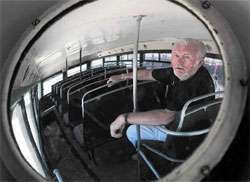
Don Vierstra of Murrieta owns three double-decker buses that he had hoped to use for a tour company. Three double-decker buses from England that Vierstra bought for $225,000 in 1993 now sit idle near his Murrieta home. | |
|
HENRI BRICKEY
Staff Writer
MURRIETA
---- In the field next to Don Vierstra's home in the west end of town,
a few things seem a little out of place. Amid the brown grass stubble,
weeds and aging clunkers, sit several European classics.
Vierstra admits his three double-decker buses turn a lot of heads.
But if people knew the story behind the buses, they'd probably take a closer look and appreciate the triplet of transporters.
Vierstra,
66, says he bought the buses for $225,000 in 1993 and planned to use
them for tours in conjunction with the Western Entertainment Center, a
western-themed entertainment and shopping center once planned for
Temecula.
"That's the only reason I bought them," Vierstra said.
When
the center went belly up in the late 1990s, Vierstra played with the
idea of using the buses for a tour company, but the idea never took off.
"I just ran out of gas," Vierstra said.
Since
then, weeds have grown around the buses' tires. Spider webs cling to
the vehicles' circular stairways and a thick layer of dust covers the
paint that once shined bright red.
But underneath all the dust are three vintage vehicles and a story about survival.
To
the untrained eye, Vierstra's buses seem like typical double-deckers.
But in the small world of double-decker bus enthusiasts, Vierstra's
buses are special.
Only 76 buses like Vierstra's were
manufactured in the early 1950s to fulfill a special function for
London Transport, the bus company serving England's capital city at the
time.
What makes Vierstra's buses unique are their height, a
characteristic that distinguishes them as RLHs (Regent Low Height), a
mutated double-decker built 14 inches shorter than its counterparts.
Their specialized height enabled them to pass through tunnels in parts
of London where bridges were built lower than in other areas.
An
anomaly among London's busing fleet, the shorter RLHs lived in the
limelight and performed a duty no other bus could do. But their special
place in London's history was short-lived.
By 1971, London's bus
routes had bypassed all the low bridges and the RLH double-deckers
became expendable. They were forced to make their living another way.
Almost
half of them were exported across the Atlantic and used by restaurants
and other businesses for advertising ---- like RLH 7, which was last
seen at a movie rental store in Topeka, Kan., in 1987, according to a
bus enthusiast club that tracks the stray RLH buses still in existence.
Several such clubs have Web sites with "survivors lists" where buses
are listed by model, serial number and last known location.
Others
buses, like RLH 59, fared worse. Fifty-nine made a long voyage across
the ocean to Atlanta in 1969, only to be mutilated in a traffic
accident several months later.
Other siblings in the RLH clan
held on longer, like RLH 26, which made it all the way to Hawaii before
being sold to a junkyard in Kailua in 1984.
Other RLHs seem to have simply disappeared.
One
Web site, posted by Timebus Travel, has whittled the number of
remaining buses down to 25, including the three in Vierstra's field
---- RLH 53, 69 and 71. Only a handful of the survivors are operational.
But it's the nature of a bus to move, and Vierstra says 53, 69 and 71 could still end up back on the road where they belong.
"I
will donate the buses to somebody if they'll pay the shipping charges,"
said Vierstra, who says he paid $15,000 to have each bus delivered to
Murrieta from London.
And if no one takes him up on his offer?
"They'll just sit there," Vierstra says. "I enjoy driving by and seeing them."
Contact staff writer Henri Brickey at (909) 676-4315, Ext. 2616, or [email protected].
7/23/01
|
Comments On This Story Add Your Comments
To begin a discussion on this topic visit our Online Forums.
|
| Click here for daily newspaper delivery | |
 | Click here for daily online news alerts |
 | Click here to send a Letter to the Editor |
| Click here to send an Announcement |